
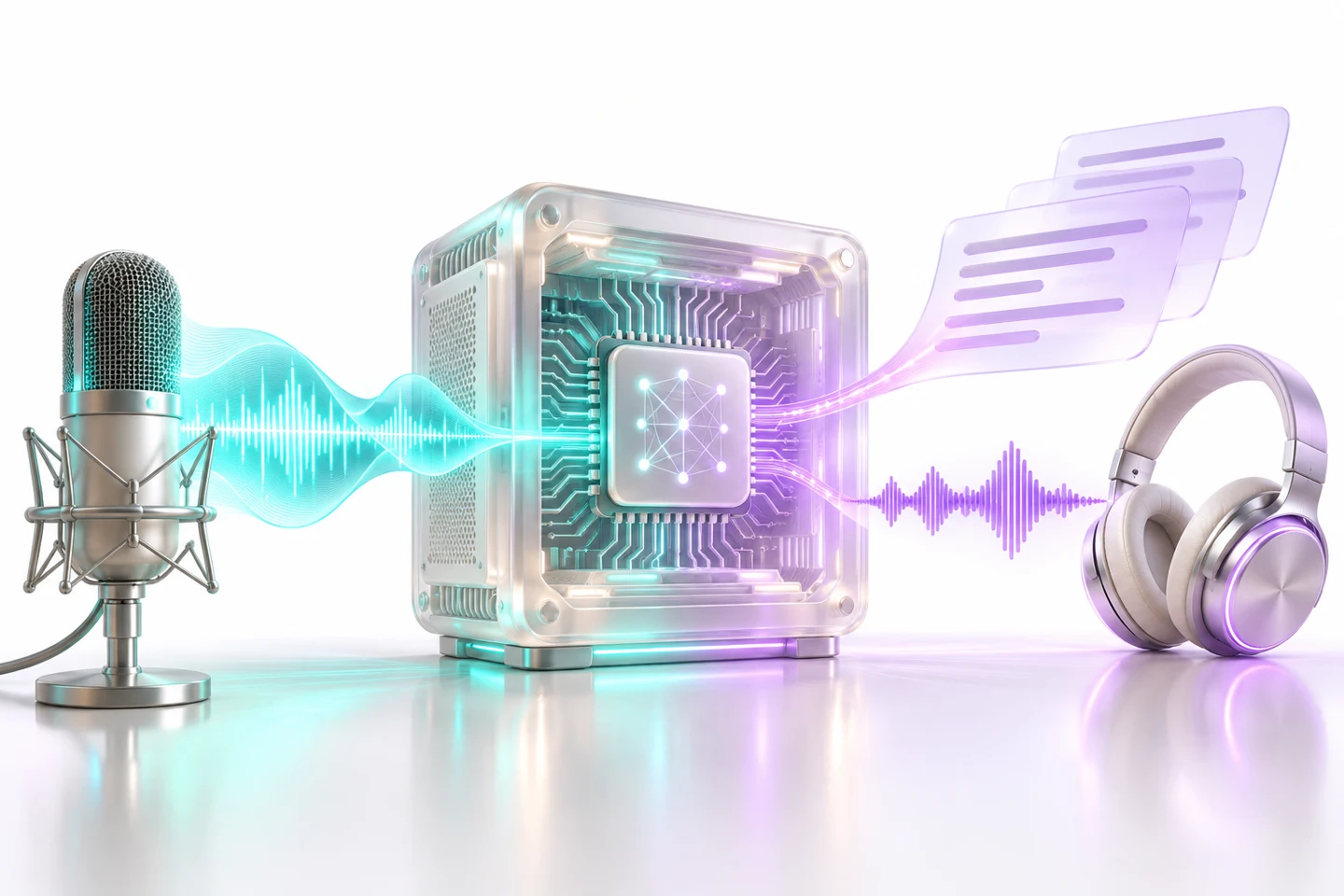
Speech synthesis has a runtime compatibility boundary
Pull request #32020 introduces a ZONOS3-Mini audio generation pipeline, a default voice, reference-audio voice conditioning and delivery controls. Its author explicitly distinguishes the original model package, which uses a customized GGML runtime, from the new llama.cpp implementation. Existing files cannot simply be assumed interchangeable. Zyphra’s official model card lists Apache 2.0 for the weights and describes support for 43 languages. Performance claims for Zyphra’s own native or browser runtimes do not automatically describe the newly merged implementation; those require measurements on the actual deployment.
Text normalization is part of the integration
The work also incorporates text normalization before speech generation. A reviewer reported end-to-end checks using Q8_0 weights with an f32 mmproj through llama-tts and /tts, covering predefined voices, speed, loudness and normalization tests. English and French renders reportedly transcribed back correctly, including numbers, money, times and ordinals. The same review identified edge cases involving French and Spanish currency phrases and English four-digit numbers interpreted as years. These are useful, attributed project observations, rather than our own benchmark or a guarantee for arbitrary narration.
Recognition support covers two related model families
Pull request #32329 brings Higgs Audio v3 STT and Microsoft VibeVoice-ASR into the same integration because, according to its author, they share a backbone. A reviewer tested Q8_0 with an f16 mmproj through /v1/audio/transcriptions, /v1/chat/completions and realtime transcription sessions on English and French clips. The report describes correct timestamps, speaker separation and prompt context for VibeVoice, including a clip crossing a 30-second chunk boundary. Short examples do not establish equivalent accuracy on hour-long meetings, noisy recordings or specialist vocabulary in other languages.
Model cards and deployment limits still matter
The official Higgs model card identifies Apache 2.0 and English, while Microsoft’s VibeVoice-ASR-HF card lists MIT and multilingual capabilities. These are publications by the model organizations on Hugging Face, rather than a separate release by the platform team. Features documented for an original Transformers implementation, including long recordings, should be checked against current llama.cpp behavior. Weight precision, auxiliary components and recording duration all affect memory and latency. The reviewed pull requests do not establish a universal hardware minimum or comparative benchmark across devices. Teams evaluating a local voice pipeline therefore have concrete integrations to inspect, but still need workload-specific validation before replacing a working system.
Discussion.
Your perspective matters. Sign in, pick a nickname and choose your cyber identity.
Loading discussion…
Your account name, email and photo stay off your comments.