
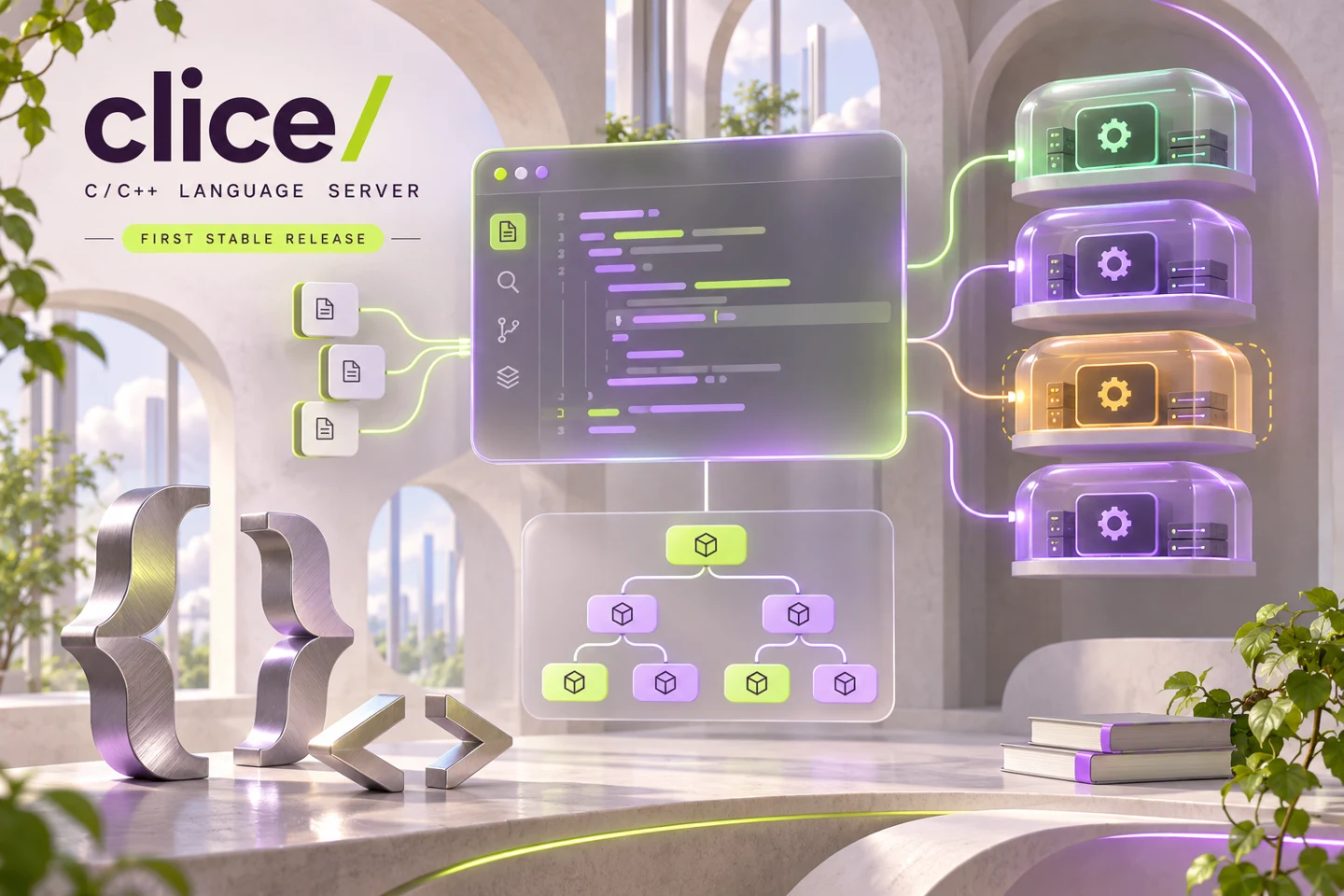
Why isolate compilation workers
The developer describes a process pool that separates compilation from the rest of the language server. A worker crashing while examining incomplete code should leave other services available. That boundary matters in an editor, where partially written expressions are normal rather than exceptional input. Process isolation is an architectural claim, however, not proof of lower memory consumption or better latency across every repository. We have not independently benchmarked clice against clangd. Teams can evaluate the claimed resilience using a reproducible problematic file and checking whether unrelated navigation remains available after a failure.
Modules depend on the compilation context
The documentation describes named C++20 modules, disk caches and selectable compilation contexts for headers and build configurations. The project expects a compile_commands.json containing the necessary module files. Our assessment is that this makes the quality of the compilation database central to an evaluation: editor behavior can change when flags, include paths or definitions differ from the actual build. Testing one small module does not establish compatibility with an entire dependency graph. A useful comparison includes both debug and release configurations, plus headers interpreted from more than one inclusion site.
An upgrade with a configuration boundary
The official release notes remove the old project and tracker tables from clice.toml. Settings move to top-level keys, worker settings or per-file rules; obsolete keys now produce an error. Existing users therefore have a concrete migration task before expecting language services to resume. The release supplies Linux, macOS and Windows packages, while the repository identifies an Apache 2.0 license. For a team rollout, the relevant question is whether its checked-in settings still resolve correctly, rather than whether the download completed. Preserve a known working setup while validating that the editor actually receives navigation and diagnostic responses.
A shared engine beyond the editor
The command-line documentation describes tools that share configuration, caches and the persistent index with the editor server. These include indexing ahead of time, clang-tidy checks, formatting, symbol queries and dependency analysis. That arrangement can make code exploration available to scripts as well as interactive users. It also creates an important limit: an index reflects the configuration and code it has seen, not a guarantee about every possible build. Automated refactoring still needs a reviewed diff, a fresh build and the project’s tests. The stable tag helps make that evaluation repeatable without turning upstream feature claims into independently verified results.

Discussion.
Your perspective matters. Sign in, pick a nickname and choose your cyber identity.
Loading discussion…
Your account name, email and photo stay off your comments.