
An integration rather than a new model launch
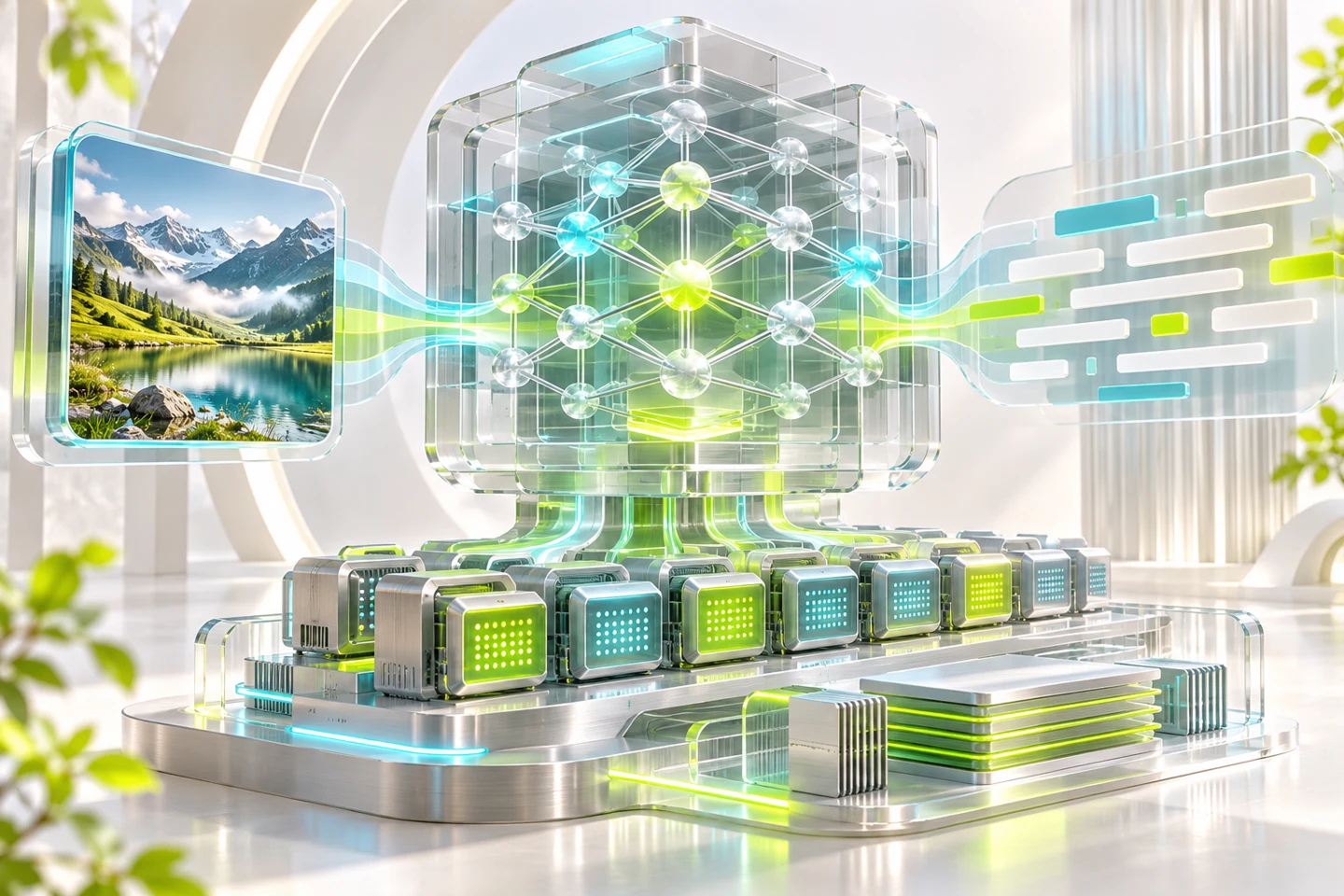
The release includes text-to-GGUF conversion, model execution and a still-image path through the multimodal components. It gives developers another implementation to investigate without changing the model’s learned parameters. The pull request explicitly leaves the DSpark speculator for separate work, so architecture support should not be equated with every proposed acceleration being available. The final integration is identified as text and vision support. Audio is not part of that claim, and a history of intermediate commits is not a reliable list of finished user-facing features.
The hardware implications of Small
Thinking Machines Lab’s model card describes a mixture-of-experts architecture with 594 billion total parameters and 17 billion active parameters per token. Its published configurations call for at least 500 GB of aggregate GPU memory for the main NVFP4 checkpoint and 800 GB for MXFP8. These are the provider’s requirements for those formats, not a minimum we measured for a GGUF deployment. Sparse activation reduces computation without making the remaining weights disappear. Runtime support alone therefore does not establish that a normal consumer laptop can serve this model comfortably.
Read the conversion results within their scope
The b12406 notes describe processing packed expert tensors in chunks rather than expanding an entire large layer at once. That approach targets temporary conversion buffers. The reported checks use synthetic fixtures, and the notes explicitly say that real-checkpoint conversion remains untested. A small buffer allocation should not be presented as the memory footprint of the whole model. We have not converted or served the complete checkpoint. There are no independent performance measurements in this report, and synthetic numerical agreement does not establish end-to-end reliability on real workloads.
What an application team can evaluate next
The weights are published by Thinking Machines Lab on Hugging Face with an Apache 2.0 license label; hosting on the platform does not make this a Hugging Face team model. For a self-hosted application, compatibility testing should separately cover conversion, the conversation template, text generation and image handling. A document-analysis workflow needs representative inputs and a comparison against its existing baseline, with the runtime version recorded. Our assessment is that this is a useful infrastructure development. A successful merge is an appropriate starting point for evaluation, while production readiness requires evidence from the intended deployment.
Discussion.
Your perspective matters. Sign in, pick a nickname and choose your cyber identity.
Loading discussion…
Your account name, email and photo stay off your comments.