
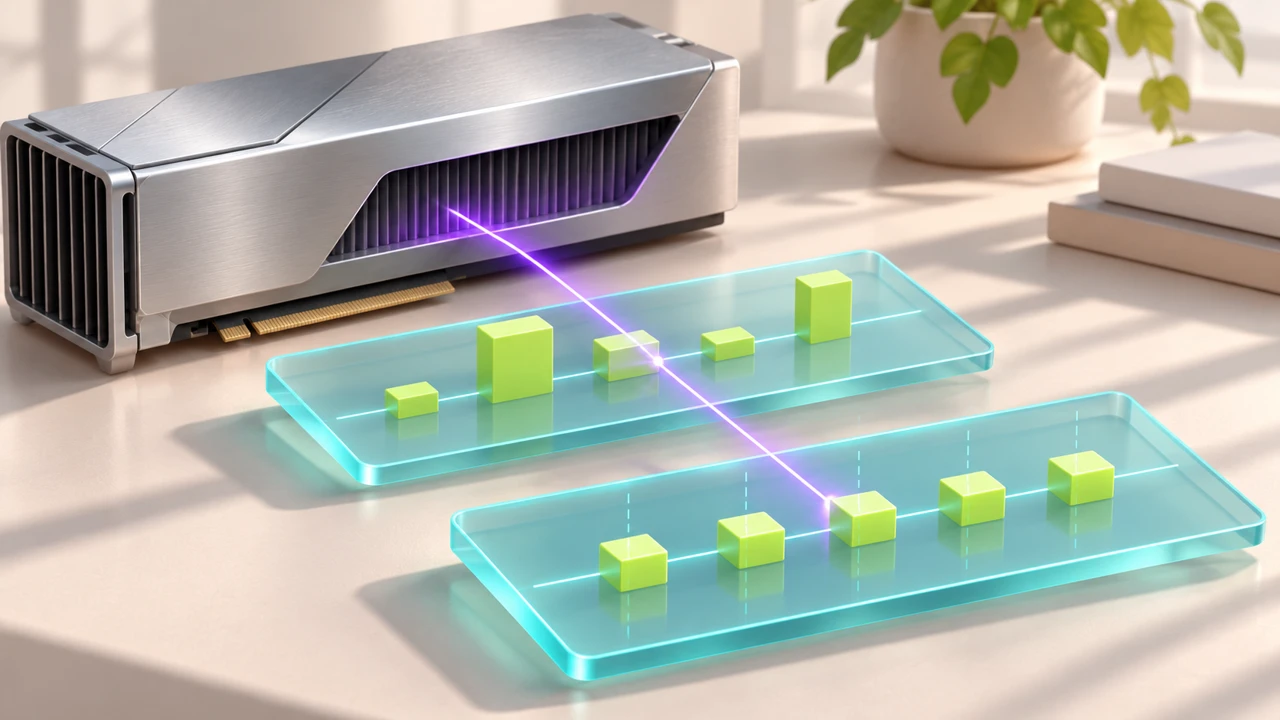
What the merged change removes
The pull request removes an extra division by two after the HIP FP8 conversion. Its stated purpose is correct gfx942 output. The release tag points to the same merged commit, so these records describe one correction.
Our interpretation is that backend conversion deserves attention alongside the choice of quantization. A file loading successfully does not establish that its scale values have been interpreted correctly by every hardware implementation. Changing prompts cannot reliably diagnose or repair an arithmetic error beneath the model.
The reported comparison has a narrow test setup
Issue 32789 documents an MI300X VF system using ROCm 7.2.0 and Ubuntu 24.04. For Inkling 2 Mini on wikitext-2, the reporter gives perplexity of 177.95 before the patch, 8.1866 after it and 8.1853 on CPU.
These are the contributor’s results, not our independent measurements. Perplexity evaluates prediction on a specified text sample; it is not tokens per second or a universal score for chat, tools and retrieval. The close CPU comparison is useful as a correctness signal within that setup, without proving identical behaviour for every workload.
Compare runtime behaviour before blaming model quality
A useful diagnostic sequence would hold the model artifact, input and evaluation settings constant while comparing the affected runtime with a reference backend. Otherwise an apparent improvement could come from a different quantization, context length or input rather than this patch.
This is our testing implication, not a report that we downloaded weights or ran the issue’s commands. We have not reproduced the hardware experiment. The official merged change supports the correction’s existence; the issue provides the attributed example of its effect.
One targeted fix, with hardware boundaries
The PR explicitly identifies CDNA3 and gfx942. Its scope should not be generalized to all AMD GPUs, every GGUF format or an unrelated CUDA path merely because some implementation files share names.
For operators evaluating an affected deployment, the relevant records are the runtime build, hardware target and quantization actually used. Our conclusion is to treat this as a correctness repair to validate against the same workload, preserving the distinction between a merged software change and an independently verified application outcome.
Discussion.
Your perspective matters. Sign in, pick a nickname and choose your cyber identity.
Loading discussion…
Your account name, email and photo stay off your comments.