
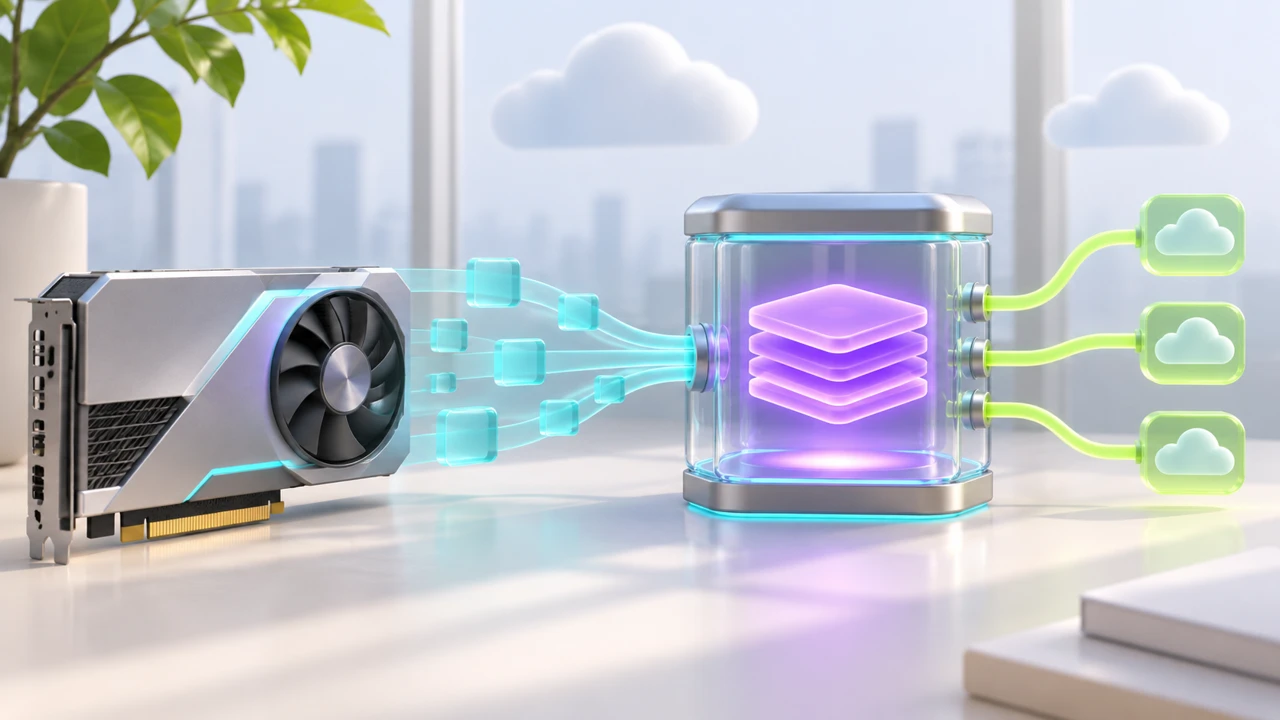
A container becomes the accelerated application step
Functions are packaged as OCI container images. AWS supplies curated CUDA, CuPy, PyTorch, vLLM and SGLang images, while also allowing custom containers. In its example, AWS uses Qwen2.5-1.5B-Instruct through the vLLM image and selects weights with MODEL_ID. That demonstration does not establish compatibility or quality for every model.
The useful architectural change is event integration: a GPU function can process an S3 upload, consume an SQS queue or serve as an inference step in a larger workflow. This does not retrain weights, create a LoRA adapter or automatically build a retrieval system. Those remain separate application choices.
Concurrency shares a model, but has a defined scope
AWS specifies up to 48 concurrent requests per execution environment. With the serving image, concurrent invocations share a model copy in GPU memory. The launch example sets concurrency to four; the maximum is not a promise that every workload can run 48 requests at its desired latency.
The published limits include 3–48 GB of requested accelerator memory, container images up to 32 GB and ephemeral storage up to 32 GB. Timeouts can extend to 90 minutes for asynchronous and event-source-mapping invocations. That longer limit should not be applied to every invocation mode.
Publishing prepares the model before traffic arrives
Managed Instances functions execute from published versions. AWS says publishing provisions environments, downloads weights and warms the inference engine before the version becomes active. A model change therefore involves a configuration update and another published version, even when the image need not be rebuilt.
AcceleratorMemorySize expresses the minimum GPU memory requested; placement can use a larger accelerator. The launch supports G4dn, G5, G6, G6f, Gr6, Gr6f and G6e families. Account quotas and regional capacity still matter, so managed provisioning should not be interpreted as unlimited immediately available GPUs.
Managed infrastructure still has provisioned costs
At launch, AWS lists underlying EC2 charges, a 9.75% GPU management fee and the standard $0.20 per million Lambda requests. Savings Plans and Reserved Instances can apply to the instance component. These are launch terms, not a workload-specific cost estimate or a guarantee of savings.
Our assessment is that utilization, model memory and the traffic pattern will determine whether this approach suits an application. The 48-request limit is a concurrency allowance, not an independently measured throughput result. We have not deployed an AWS resource or reproduced the vendor’s demonstration; the source announcement and its stated operating limits are the basis of this report.


Discussion.
Your perspective matters. Sign in, pick a nickname and choose your cyber identity.
Loading discussion…
Your account name, email and photo stay off your comments.