
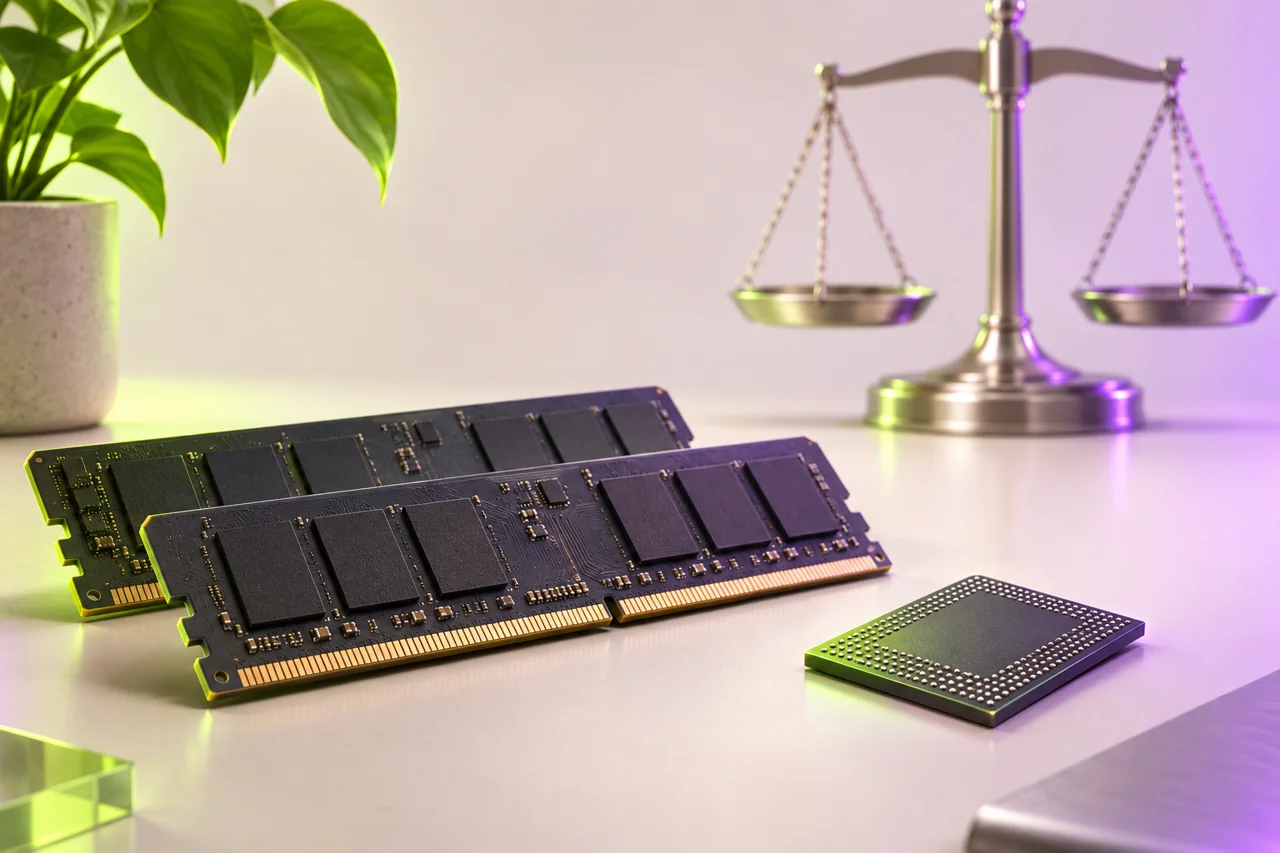
What the ruling decides
The court denied the defendants’ joint motion to dismiss. Seventeen consumers and small businesses allege that Samsung, SK hynix and Micron coordinated restrictions on conventional DRAM supply. The manufacturers argue that their decisions reflected independent responses to market conditions and their own commercial interests.
At this stage, the court examines whether a complaint contains sufficiently specific allegations to proceed. Well-pleaded factual allegations are accepted as true for that limited assessment. The order does not resolve liability, determine damages or establish the ultimate outcome. Readers should preserve that distinction when discussing the case or sharing its headline.
How DDR4 and HBM enter the dispute
The complaint connects conventional memory production cuts with a shift toward high-bandwidth memory for AI accelerators, product-line exits and manufacturing-capacity decisions. These are the purchasers’ allegations. Their inclusion in the court’s background discussion does not independently establish every market estimate or business interpretation described in the complaint.
Our technical context is that DDR4 and DDR5 serve as system memory, while HBM is closely integrated with demanding computing accelerators. AI infrastructure demand can therefore change the allocation of manufacturing resources. Similar shifts by competing suppliers do not, on their own, establish an unlawful agreement. The dispute concerns whether additional circumstances support the purchasers’ theory.
The court weighs the arguments separately
Judge Wise considered the combined significance of allegations concerning long-term HBM commitments, capacity decisions, the DDR4 exit and similar customer-vetting practices. In the court’s assessment, the allegations collectively meet the plausibility threshold needed to keep the claim alive. That assessment leaves factual disputes for subsequent proceedings.
The order also accepts some defense arguments. A move toward HBM when it was more profitable was insufficient by itself, and ordinary public statements to investors did not support the alleged inference in the way the plaintiffs proposed. Reporting the decision accurately requires acknowledging those limits alongside the overall denial of dismissal.
What happens next for the case and memory buyers
The defendants’ answers are due no later than December 7, 2026. The initial case-management conference has been moved to January 12, 2027. The complaint was filed in June; the new event reported here is the November order refusing to dismiss it. A later discussion on Hacker News does not change the underlying event date.
For PC purchasers and infrastructure operators, the case is a reason to follow future evidence about memory-market competition. It does not set new retail prices, order an immediate production increase or guarantee compensation to individual customers. Our practical assessment is to base purchasing decisions on actual supplier quotations and hardware compatibility while treating the eventual consequences of the litigation as uncertain.


Discussion.
Your perspective matters. Sign in, pick a nickname and choose your cyber identity.
Loading discussion…
Your account name, email and photo stay off your comments.