What the product combines
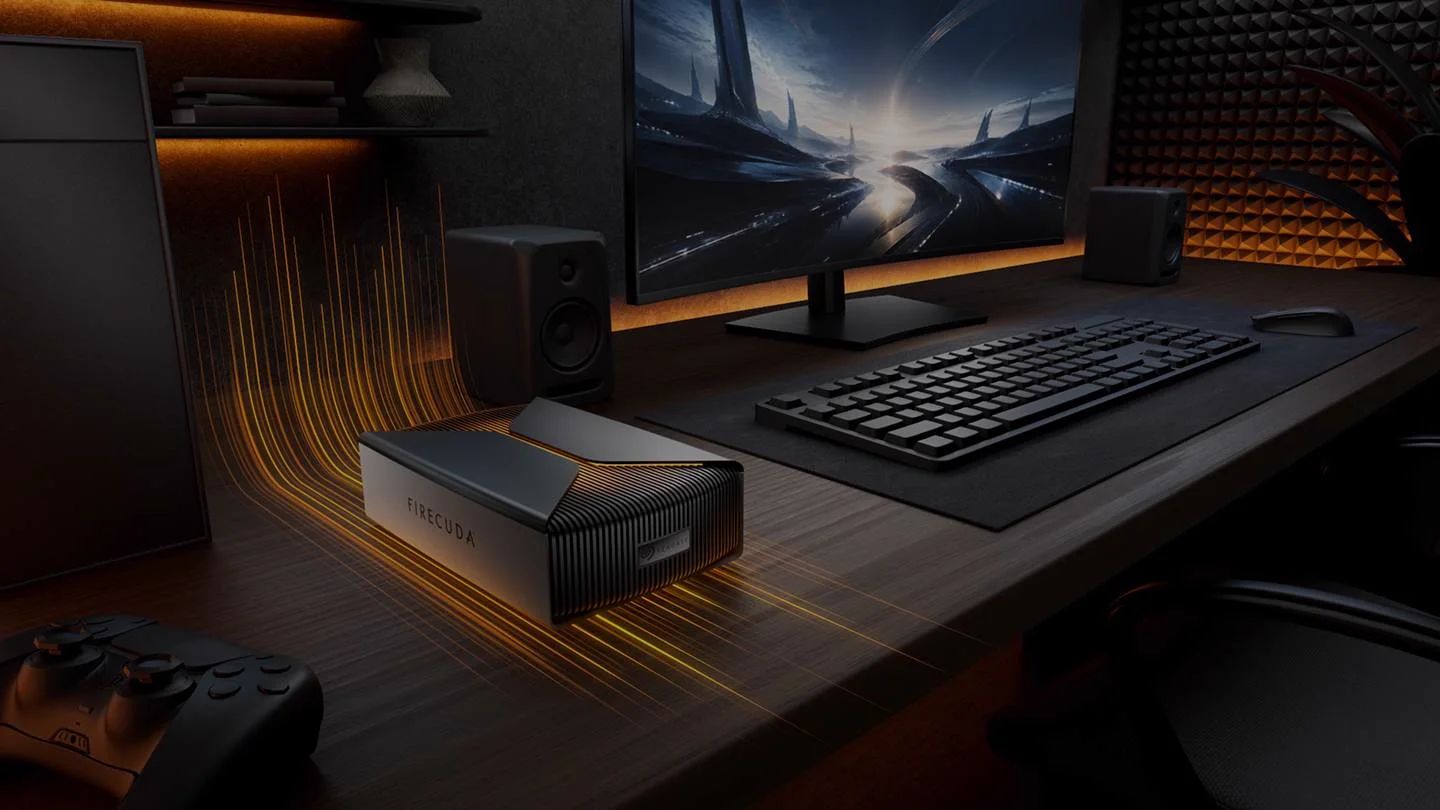
FireCuda Forge pairs mechanical storage capacity with a separately installed NVMe solid-state drive. Seagate describes Alkemi, the platform managing placement inside the device, as adapting to keep frequently needed content accessible on the SSD while the HDD holds a growing library. The required SSD is supplied by the user. That makes the complete configuration, not just the enclosure price, the relevant unit for comparison. Buyers also need to check the supported SSD specification instead of assuming that any spare NVMe drive will work.
Peak speed needs context
A hybrid system can behave differently depending on which files are requested and where their data currently resides. Repeated reads of frequently used files are not equivalent to copying a large unfamiliar library. Interface bandwidth likewise does not guarantee the speed of every operation. This is our technical assessment of hybrid storage, not a benchmark we have performed on FireCuda Forge. Until independent testing establishes workload behavior, advertised figures should remain identified as manufacturer claims. Sustained transfers, a full fast tier and recovery after interrupted writes are separate questions from a short favorable speed test.
Failure behavior remains important
Ars highlights unresolved details about Alkemi placement and recovery when one storage device fails. Caching, mirroring and distributing different blocks across two drives imply different data-recovery properties. It would be inappropriate either to assume the new design repeats every weakness of older hybrids or to declare those weaknesses solved without documentation. For important files, operators need clear answers about replacing the SSD, recovering the volume and accessing surviving data after a physical failure. Those procedures determine operational risk more directly than the familiarity of the hybrid concept.
How to assess the tradeoff
A useful comparison includes complete cost, usable capacity, sustained performance and a backup plan. Two storage devices in one enclosure do not automatically constitute a backup. Test the actual operating system and representative workloads, whether games, video or development projects. FireCuda Forge is interesting because it tries to combine the different strengths of HDDs and SSDs. Its practical value will depend on measured behavior and transparent storage-management rules, rather than on the return of an old idea or a single favorable headline specification.