What AMD announced
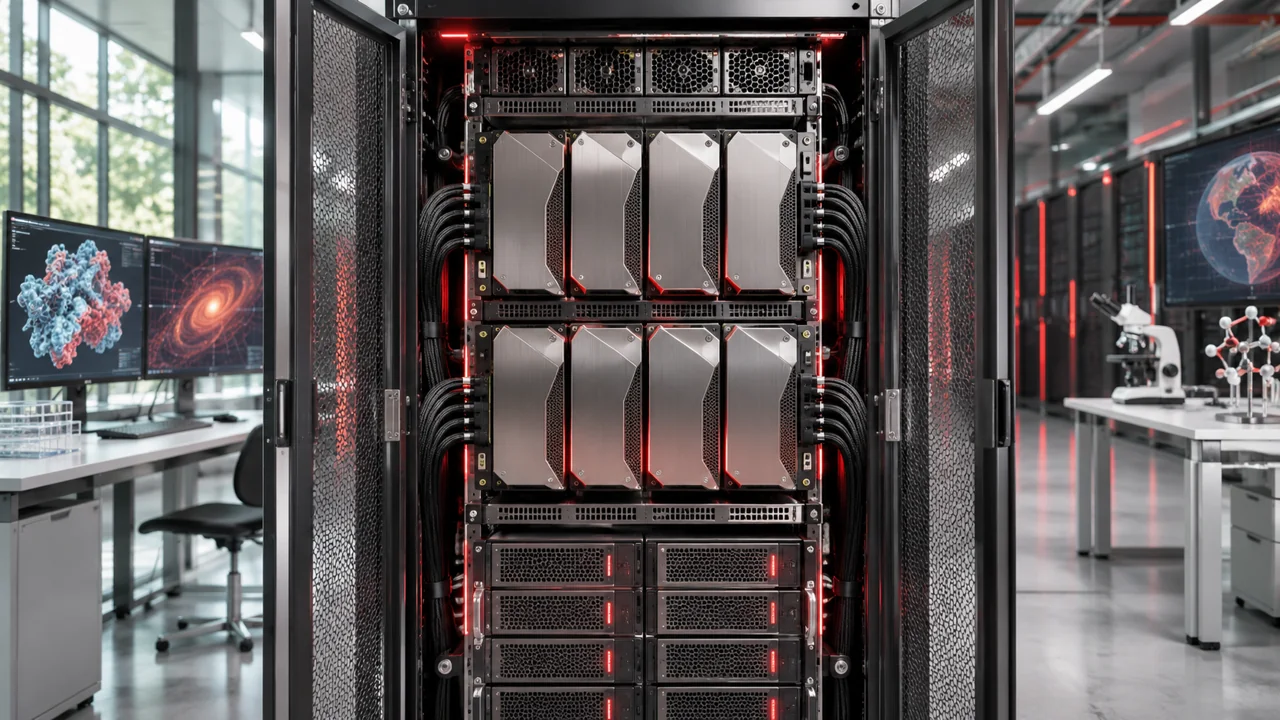
AMD highlighted MI430X for scientific work, new MI455X results on Helios and an MI450X configuration. It lists 432GB of HBM4 and up to 23.3TB/s memory bandwidth for MI430X, alongside native FP64 computation.
Different workloads need different criteria
Our interpretation is that accelerator selection starts by describing the computation. One project may depend on numerical precision, while another needs to serve a large model to many requests. A comparison without that definition risks turning unrelated tasks into one ranking.
Record required precision, input sizes and acceptable completion time before evaluating hardware. That distinguishes necessary characteristics from presentation-friendly figures that do not materially affect the project. It also makes the reasoning behind a purchase or migration easier to review later.
Evaluate inference in the intended serving mode
We suggest checking both response latency and behavior under load. A high batch-processing throughput number does not automatically establish how long someone will wait in an interactive application. Define the intended service experience before choosing which benchmark to reproduce.
A meaningful comparison needs matching models, precision and measurement rules. Identify what the configuration includes as well: an accelerator or an entire system. Otherwise, values from different tables can create an inaccurate impression of a platform’s advantage.
What a team should test before switching
Prepare a small set of representative tasks and examine the whole workflow: initialization, execution, output collection and correctness checks. For scientific code, preserve enough detail to explain numerical differences between configurations rather than treating every difference as harmless.
Consider the software environment and maintenance effort alongside speed. A faster individual test does not establish the complete case when migrating the workflow requires substantial changes. Record those costs next to the measurement, including the work needed to repeat it reliably.
The useful takeaway
AMD’s announcement describes several workload directions within one accelerator family. In our assessment, readers should compare complete configurations against their own tasks. The specifications above are attributed to AMD; we have not independently tested the hardware or reproduced its performance claims.