
Scaling the output
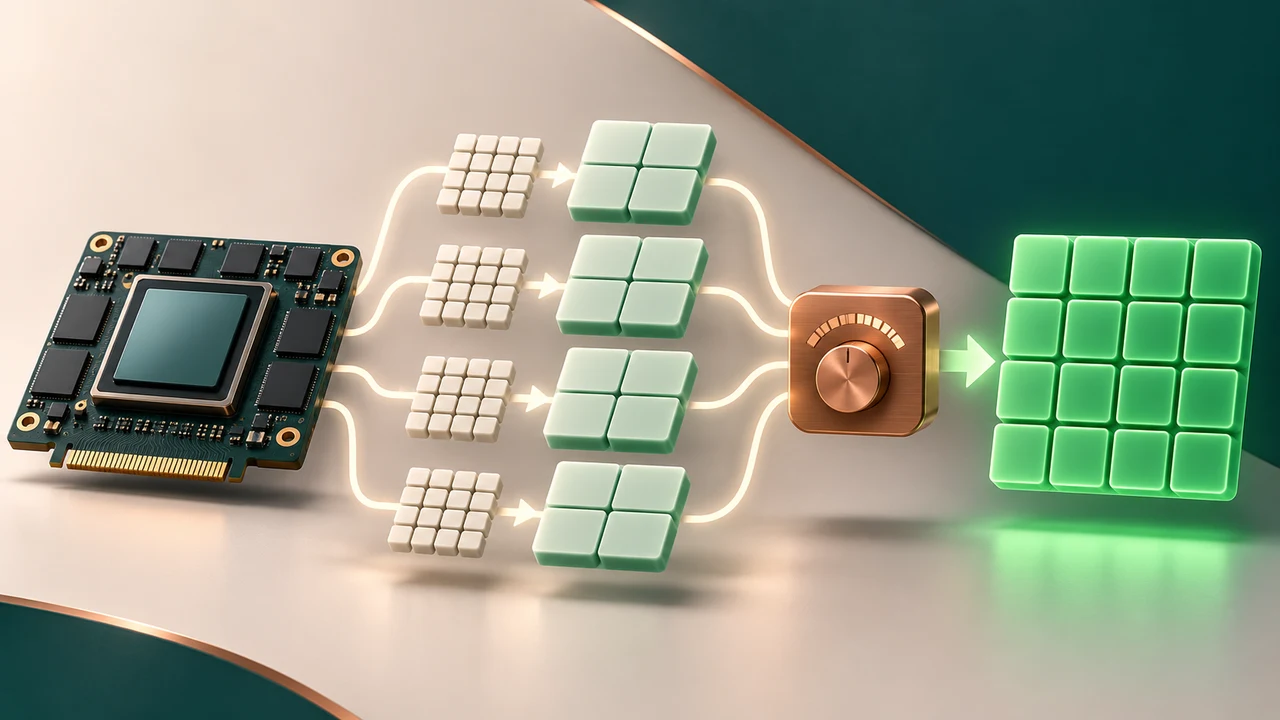
The release describes a small kernel applied after the matrix product. Its scale can cover a tensor, an output channel, an expert, or an output channel within an expert. MUL_MAT_ID obtains the expert selection from ids, while skipped positions must be preserved. Activation scales remain ignored in the stated implementation. Weight-scale support should therefore be read as a defined backend capability, with a specific scope, rather than a promise that every possible tensor-scaling arrangement now works.
The merged implementation
The diff introduces a scaling shader and dispatches it after both matrix operations. It also removes the supports_op rejection for scaled weights. In tiled MUL_MAT_ID, accumulation and conversion before multiplication use f32, while the shared-memory tiles remain f16. Storage precision and accumulation precision therefore serve different purposes. The new shader’s expert-specific branch returns for negative expert identifiers. These details explain the corrected execution path without requiring readers to treat the illustration as an actual GPU architecture diagram.
Reported tests and tradeoffs
The contributor reports 18,130 passing backend-operation cases and full WebGPU loading for Gemma 4 26B and Inkling 2 Mini UD-Q8_K_XL. Reported Inkling perplexity is 4.538 against CUDA’s 4.546. Its f32 accumulation costs roughly seven percent of prompt-processing performance against the incorrect f16 path that produced infinity. These measurements are attributed to upstream; we did not reproduce them. The PR showed 24 of 25 checks passing, which does not support describing the entire CI suite as successful.
What local users can infer
Our interpretation is that a numerically valid computation is the meaningful baseline for this change. Comparing it only with a faster path that overflows can obscure the practical benefit. The quoted percentage does not establish WebGPU performance against CPU, CUDA or Metal across deployments. Device memory, drivers and the chosen checkpoint still require workload-specific evaluation. No universal minimum GPU-memory requirement is established here. This release is distinct from earlier Inkling graph optimization and Metal ADD-chain ordering work: sharing a model name does not turn separate code changes into one event.

Discussion.
Your perspective matters. Sign in, pick a nickname and choose your cyber identity.
Loading discussion…
Your account name, email and photo stay off your comments.