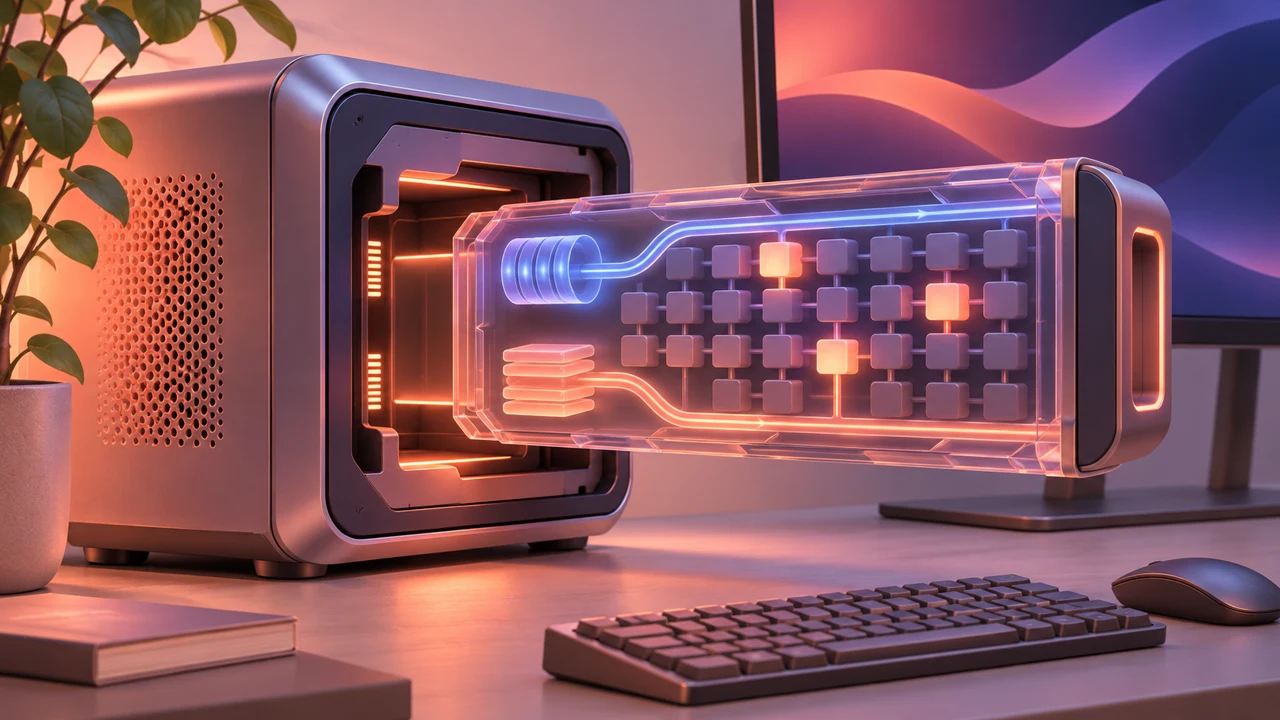
The change covers the execution path
The integration adds a model computation graph, Hugging Face-to-GGUF conversion, quantization rules, tokenizer support, a chat template and tests. The release includes RAON pre-tokenization and NFC normalization, as well as dequantization of source MXFP8 weights during conversion. These are substantive runtime compatibility changes. They do not constitute fine-tuning, a new checkpoint or a change to KRAFTON’s license. Published setup instructions also should not be confused with an execution result: this report checks the source material without installing the integration or downloading model weights.
Active parameters and resident weights differ
KRAFTON’s card specifies 28.8 billion total parameters and 4.3 billion activated per token, with six routed experts and one shared expert active. Of the model’s 25 layers, 18 use Raon Delta Attention with fixed-size state and seven use gated MLA with a KV cache. Sparse activation reduces active computation; it does not remove the need to store the other weights. The advertised 262,144-token context describes model capacity. A working runtime configuration still depends on supported operations, available memory and the context actually allocated for the workload.
GGUF file sizes are not a complete memory budget
We checked repository file metadata without retrieving the weights. IQ4_XS is 16.07 GB, Q4_K_M is 19.69 GB, Q5_K_M is 22.18 GB, Q6_K is 25.84 GB and Q8_0 is 30.69 GB in decimal units. Those numbers describe files rather than a promise that an equally sized RAM or VRAM allocation is sufficient. Cache, temporary buffers, operating-system use, context length and CPU/GPU placement contribute additional requirements. The card’s separate RTX 5090 example uses an NVFP4 serving profile; it does not establish the same hardware fit for these GGUF configurations.
Reported tests are narrower than performance guarantees
The pull-request author reports 420 passing architecture cases, plus tokenizer and chat tests. In the discussion, the author also describes running IQ4_XS with a quantized cache and an earlier Q4_K_M CUDA 13.0 test. These are attributed integration-author results, rather than independent measurements by this publication. A Metal fusion test in the changes does not establish performance on every Mac. Likewise, a separate DFlash2 artifact and instructions for the vendor fork do not prove complete speculative-decoding parity in upstream b12758. No universal speed multiplier follows from this release alone.
Preview identity, access and licensing need separate treatment
The base and GGUF cards identify Apache 2.0 for the published components and describe access on request. They also point to newer repositories without the preview suffix; those references do not change the specific checkpoint identity covered by b12758. The cards still contain an older statement that upstream support is pending, superseded by the verified merge and release. Hosted API and playground terms are separate from the weights’ license. Chat-template support and agent-oriented use also do not authorize tool execution, which remains a decision for the application and its operator.

Discussion.
Your perspective matters. Sign in, pick a nickname and choose your cyber identity.
Loading discussion…
Your account name, email and photo stay off your comments.