
Three views keep the comparison specific
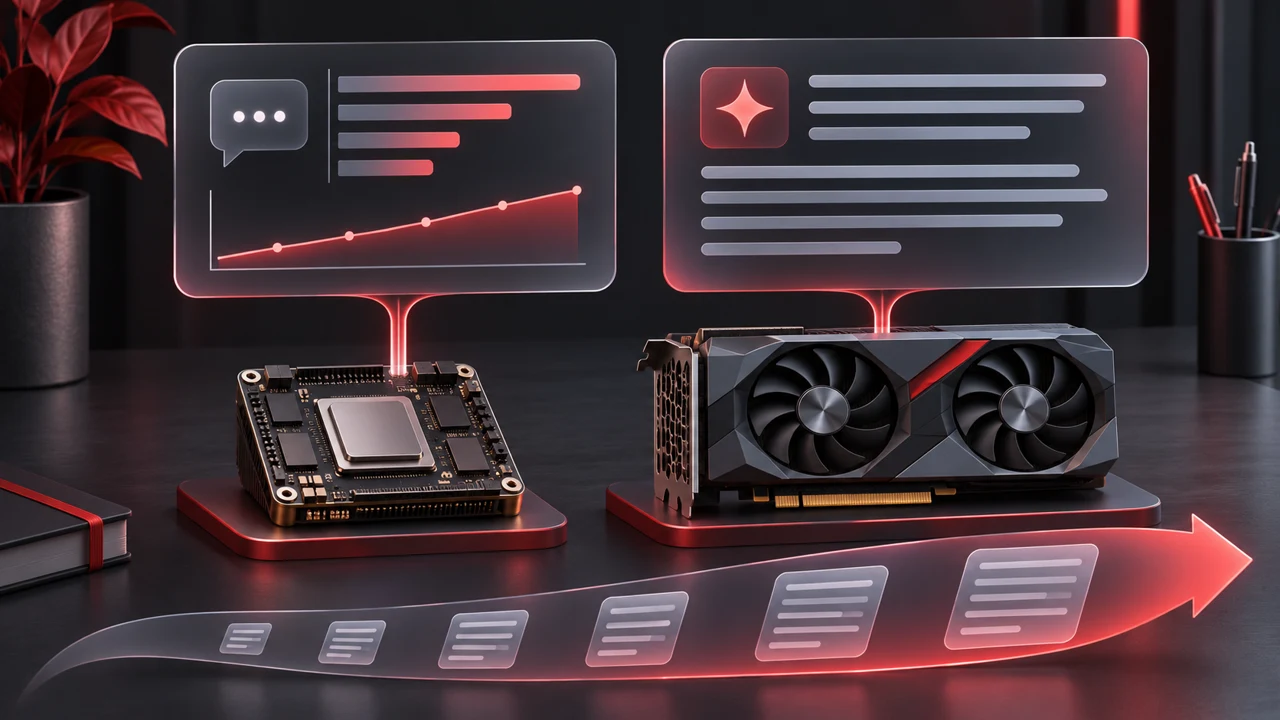
At inspection, the hardware selector offered Ryzen AI Max+ 395, identified as gfx1151, and Radeon AI Pro R9700S, identified as gfx1201. The article also describes the first configuration through its Radeon 8060S graphics. Overview compares quantizations for one hardware/model/build combination. Build history follows recorded builds, while Context scaling examines generation as existing context increases. A meaningful comparison therefore requires more than a graphics-card name: the selected model, quantization, runtime build and attention mode all define the result.
Prompt ingestion and generation are separate tests
PP512 processes 512 input tokens without generation. TG128 generates 128 tokens. Both standard workloads begin at context depth zero, and the plotted avg_ts is mean throughput in tokens per second. A large PP512 number does not imply an equally fast chat response: prompt processing and sequential decoding impose different workloads. The dedicated context-scaling view exists because a populated context can change generation performance. Neither reference workload alone measures the latency and throughput of a complete multi-user application.
A concrete number needs its complete configuration
For example, the inspected b12765/gfx1151/Qwen3.5-0.8B selection displayed 216.7 tokens per second for Q4_K_M TG128 with Flash Attention enabled. That is a result for a small model, a short generated sequence and an initially empty context. It does not describe every Qwen model, measure answer quality or establish server performance under concurrency. The dashboard’s latest label also identifies the newest recorded build in its dataset; it need not match the newest upstream release available elsewhere.
The benchmark workflow is inspectable
The authors use prebuilt binaries distributed through llama-install.sh and run the llama-bench tool. Both checked hardware workflows have weekly schedules, run Flash Attention on and off, and request ten repetitions per configuration. A separate generation sweep covers context depths from 512 through 32,768 by doubling. These files document the current published method; they do not establish identical environments for every historical record. Investigating an apparent regression still requires opening the relevant measurements and checking their recorded parameters rather than comparing isolated chart bars.
Public records make follow-up analysis possible
The explorer reads the ggml-org/install.sh-benches-data Storage Bucket on Hugging Face. Standard results use build/hardware/model/quant.jsonl, while context sweeps use a -tg.jsonl suffix. The data source link opens the selected combination’s folder, connecting a chart to its records. The evolving collection spans dense and mixture-of-experts models, including Inkling, Qwen, Gemma, gpt-oss and LFM. Developers can use the records as reference points for their own measurements. This publication inspected the dashboard and workflows without installing binaries, downloading weights or independently reproducing the tests.

Discussion.
Your perspective matters. Sign in, pick a nickname and choose your cyber identity.
Loading discussion…
Your account name, email and photo stay off your comments.