
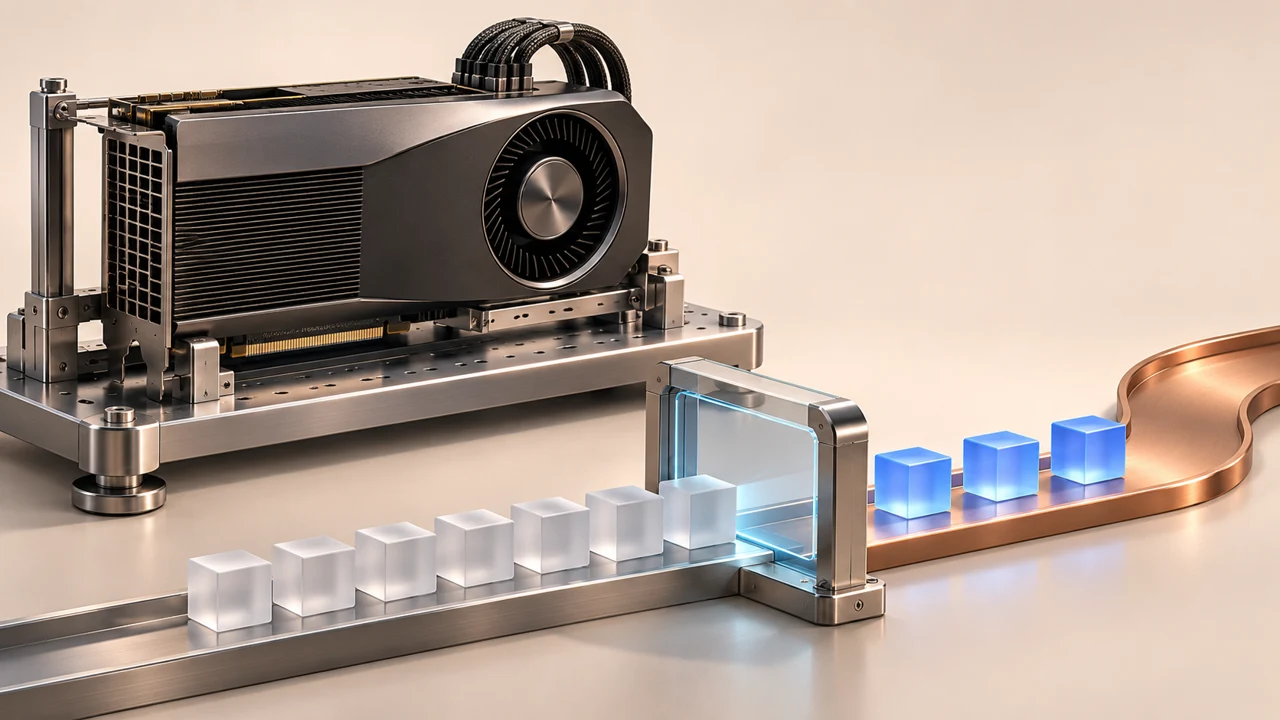
Controls define the comparison
The baseline used SGLang with fa4 attention and no speculative decoding. A coding agent followed an inference-optimisation skill that required hardware measurements first, one change at a time and candidate runs bracketed by two controls. Regressions and rejected ideas were recorded alongside successful settings. The post describes 46 valid benchmark runs. This approach helps distinguish a configuration improvement from changing experimental conditions, while the limited request panel still defines the scope of the results rather than representing every application workload.
Two changes supplied the gain
Switching to vLLM nightly without speculation produced 157 tokens per second. Enabling DSpark with seven draft tokens and probabilistic draft sampling raised the reported rate to 190.6. The table gives eight-user aggregate throughput of 716 tokens per second, compared with roughly 570 for the baseline. Aggregate throughput is different from each user’s decoding rate. These are the author’s measurements; our publication did not reproduce them. The comparison does not establish a general ranking of every vLLM and SGLang version across unrelated models.
Memory settings narrowed the usable context
The initial million-token KV-cache configuration could not coexist with the drafter in available memory. The experiment reduced max-model-len to 262144 and set gpu-memory-utilization to 0.85 to reserve room for the additional drafting model. The successful setup pins a vLLM nightly image and a specific Inkling revision. Thinking Machines Lab’s model card labels the weights Apache 2.0, while environment and hardware compatibility remain separate requirements. A recipe checked on sm120 hardware does not establish identical behavior on a different architecture or a smaller GPU.
Correctness checks were specific gates
The report shows byte-identical greedy outputs with and without speculation for six prompts, plus needle retrieval checks around 127,000 and 250,000 tokens and a concurrent long-request soak. The repository provides a gate ledger and experiment log. Those checks are useful evidence, but six matching outputs do not prove equality for every possible response, and needle retrieval is not a complete evaluation of reasoning over long documents. This work tunes inference configuration without LoRA training or changes to the model’s learned weights.
Failed experiments make the account useful
The author documents JIT compilation contaminating timed prefill, servers that remained alive, memory failures hidden earlier in logs and apparent improvements that disappeared against fresh controls. Greedy draft sampling actually reduced speed at temperature 1.0. The selected configuration was deployed with a pinned image digest; the internet endpoint also incurred network latency. We read the post, repository README, experiment and gate logs, and model card without executing scripts, creating GPU Jobs, contacting an authenticated endpoint or provisioning paid resources.


Discussion.
Your perspective matters. Sign in, pick a nickname and choose your cyber identity.
Loading discussion…
Your account name, email and photo stay off your comments.