
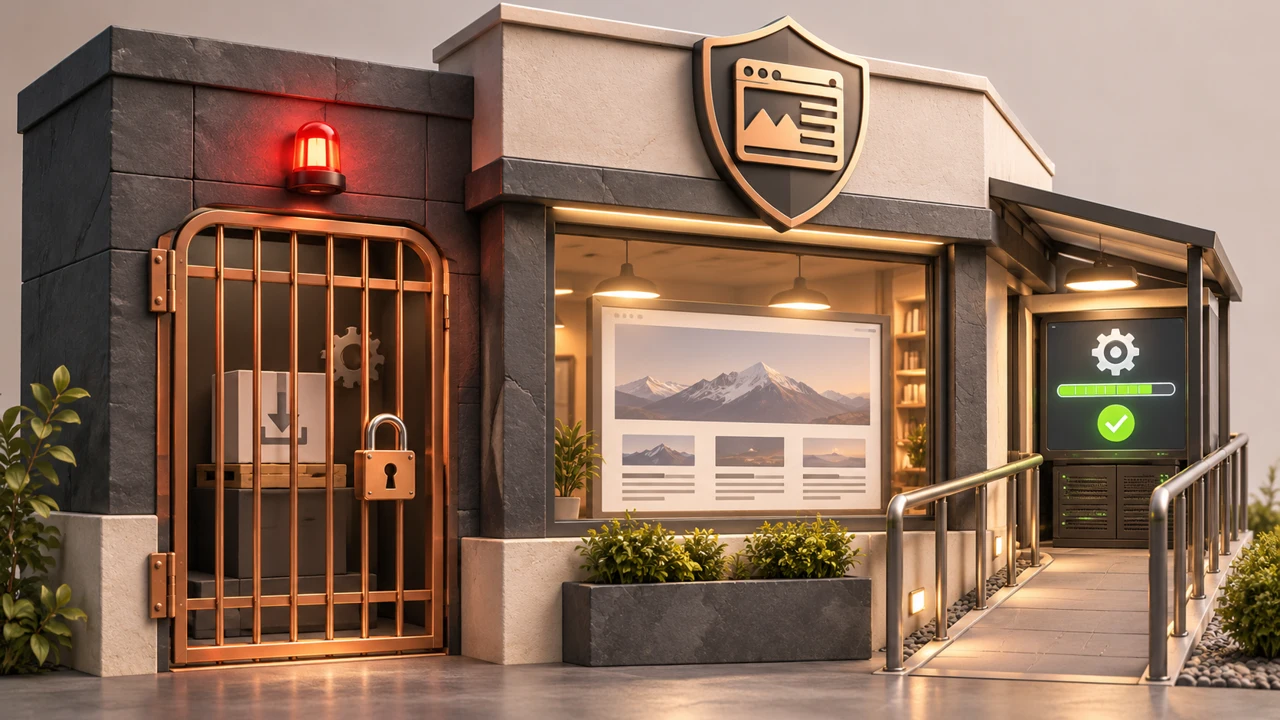
A production site can retain an affected state
The advisory says unusual or incomplete installation states can remain susceptible to site takeover after the earlier fix, including on production sites. The interface does not reliably reveal that state. Drupal also explicitly says sites with an already secured installer are not vulnerable through this path. Consequently, a normal-looking page and an operational site are not sufficient evidence of either safety or compromise. Exposure depends on the actual installer protections and installation state, rather than a superficial visual check.
Remediation has two distinct parts
The fixed releases are Drupal 11.4.14, 11.3.23 and 10.6.23 in their respective supported branches. Administrators must then run update.php: an update hook fixes existing production sites in the affected state. Delivering new PHP files and completing the data update are therefore separate steps. The release notes direct administrators back to the security advisory, so seeing a newer version number in an inventory does not by itself establish that the full required procedure has completed successfully.
The installer and updater have different jobs
The official hardening guide recommends restricting /core/install.php after installation. It identifies update.php as a separate script, so an overly broad blocking rule must not accidentally remove the maintenance path needed for updates. For Apache, the guide distinguishes server-configuration directives from .htaccess rules; for Nginx it discusses URLs containing additional path text after install.php. The practical implication is to verify how the web server actually handles requests, rather than treat the presence of a configuration entry as proof that access is blocked.
Protection must survive the next deployment
The guide explains that Composer can regenerate scaffold files, so a manual .htaccess edit may disappear during a later dependency installation. An install.php file removed manually can similarly return when core is updated. This is a persistence requirement for local hardening, not a newly announced Composer vulnerability. A site’s hosting and deployment process determine how to preserve the protection. This editorial review did not modify external servers or run their updates; it examined the advisory, release information and hardening documentation.
A patch does not settle incident history
Drupal recommends reviewing logs for unauthorized access, especially unexpected changes to or by user 1, checking control of that account’s email and considering a password reset. A compromised site may no longer display its original vulnerable state. Passing a current configuration check therefore does not establish that an earlier intrusion never happened. Signs of compromise call for incident response rather than merely applying the patch again. Unsupported branches also lack normal security coverage and cannot be treated as maintained simply because the site still runs.


Discussion.
Your perspective matters. Sign in, pick a nickname and choose your cyber identity.
Loading discussion…
Your account name, email and photo stay off your comments.