
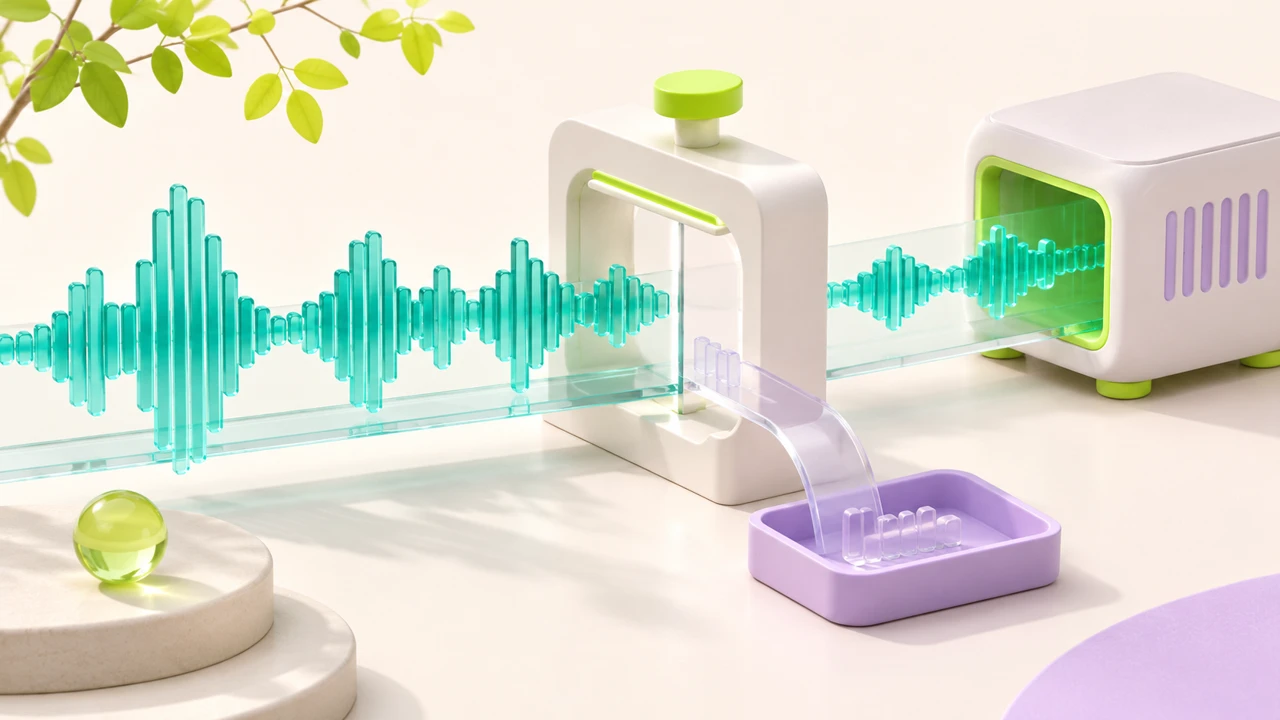
A boundary error could create a phantom chunk
The November 20 report concerns Qwen3-Omni and Qwen3-ASR audio handling. It identifies an extra frame at a boundary and padding to complete chunks as a source of fabricated tail tokens. Its concrete example uses Qwen3-ASR-0.6B GGUF on an Apple M4 Pro system.
The count in that reproduction refers to internal audio tokens, not words in a transcript. Halving 26 to 13 therefore does not mean a twofold transcription speedup, a shorter spoken recording or a measured reduction in recognition errors. Those claims would require different evidence.
The patch preserves the real frame count
The final diff keeps the effective length of preprocessed audio windows, rather than expanding every output window to a complete padded chunk. The graph still applies zero-padding where needed for its convolutional processing, then drops outputs corresponding to that padding before the encoder layers.
A shared frame-to-token calculation now serves both the graph and output-token reporting. The implementation distinguishes complete 100-frame chunks from the final partial chunk, applying the same successive rounding rules to its tail. This reduces the risk that separate calculations silently diverge.
Tests cover several lengths and window boundaries
The merged tests include empty and very short input, exact windows and audio extending beyond one window. Separate frame-count cases check that 100 frames produce 13 tokens, while 101 frames produce 14, alongside other complete and partial lengths.
The PR author describes a test-first approach and compares the path with the official Qwen3-ASR Transformers implementation. We reviewed the report and code changes; we did not run the tests, transcribe private audio or independently measure recognition quality.
Scope is the local runtime, not a new speech model
The merged correction is dated November 22, while the original bug report is dated November 20 and the release metadata appeared later. These records describe one repair, rather than separate model launches. No new weights, language coverage or LoRA training capability is announced by this patch.
For an integration evaluation, the relevant comparison is the actual input length, preprocessing frame count and downstream audio-token count on the affected model path. Our assessment is that maintaining those boundaries is a prerequisite for trustworthy speech evaluation. It does not establish that every remaining transcript error is caused by padding, nor that this change applies to every audio architecture supported by llama.cpp.

Discussion.
Your perspective matters. Sign in, pick a nickname and choose your cyber identity.
Loading discussion…
Your account name, email and photo stay off your comments.